

Cybersecurity for Universities: 6 Major Challenges in the Age of AI
Marma Security
Marma Security Expert
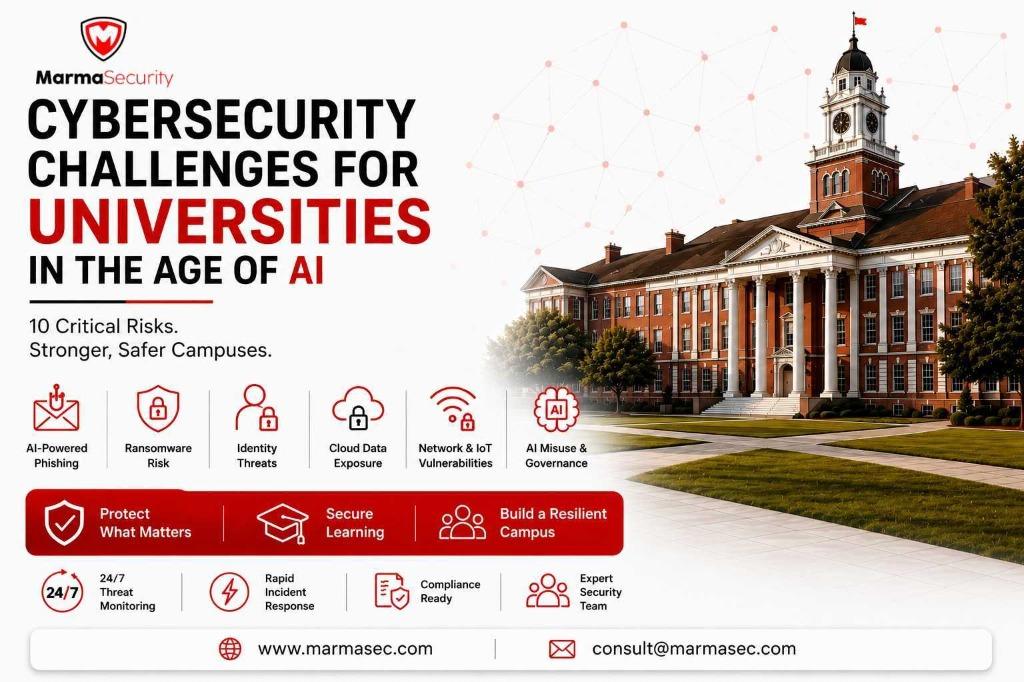
Introduction
Artificial intelligence is changing higher education. Universities use AI to support teaching, research, administration, analysis, and student services. These tools can create meaningful benefits, but they also introduce new security and governance questions.
Attackers can use generative AI to create more convincing messages, personalize social engineering, and scale their efforts. Universities must also protect large and changing populations of students, faculty, researchers, contractors, and partners across personal devices, campus networks, cloud applications, research systems, and third-party platforms.
Cybersecurity is therefore more than an IT concern. A serious incident can affect teaching, examinations, research, student services, institutional trust, and business continuity. The goal is not to stop AI adoption; it is to enable innovation with appropriate safeguards.
Key Cybersecurity Challenges for Universities
- AI-powered phishing and social engineering
- Ransomware and data extortion
- Identity attacks and compromised credentials
- Shadow AI and sensitive-data exposure
- Research-data and intellectual-property theft
- BYOD, IoT, and expanding campus attack surfaces
These risks should be addressed alongside core controls such as multi-factor authentication (MFA), least-privilege access, endpoint protection, network segmentation, vulnerability management, continuous monitoring, secure backups, and tested incident response.
1. AI-Powered Phishing and Social Engineering
Phishing is not new, but generative AI can make fraudulent messages easier to personalize and produce at scale. A message may appear to come from a university administrator, professor, IT department, research partner, financial-aid office, cloud provider, or vendor.
If a user gives away credentials or opens a malicious attachment, attackers may attempt to access email, cloud storage, academic systems, or internal applications. Universities should not rely on staff and students identifying every suspicious message.
Practical safeguards include MFA, phishing-resistant authentication where feasible, email security, conditional access, identity monitoring, user reporting procedures, and regular awareness exercises. The objective is to prevent one mistake from becoming a campus-wide incident.
2. Ransomware and Data Extortion
Ransomware can interrupt learning-management systems, student portals, examinations, email, administrative applications, research environments, and campus networks. Some attacks also involve stealing data and threatening to publish it.
Potential consequences include cancelled or delayed activities, unavailable services, research disruption, exposure of sensitive information, financial costs, and reputational damage.
Universities should maintain secure and appropriately isolated backups, test restoration rather than merely backup completion, patch exposed systems, use endpoint detection and response where appropriate, segment critical networks, restrict privileged access, and rehearse incident-response procedures. A recovery plan should identify who makes decisions, how stakeholders are informed, and which services must be restored first.
3. Identity Attacks and Account Compromise
University populations change continually. Students graduate, employees change roles, visiting researchers join projects, and contractors receive temporary access. If account lifecycle processes are weak, old accounts or excessive permissions can remain active.
A compromised identity may expose email, cloud storage, academic systems, research resources, financial information, or internal applications.
Recommended controls include MFA, role-based access, least privilege, automated account provisioning and deprovisioning, regular access reviews, privileged-access management, and monitoring for unusual sign-ins. Access should be granted for a defined purpose and removed when it is no longer needed.
4. Shadow AI and Sensitive-Data Exposure
Students, faculty, researchers, and staff may use public AI tools to summarize documents, analyze datasets, write code, draft reports, or automate routine work. Risk increases when people submit confidential information to services that have not been reviewed or approved by the institution.
Sensitive material may include student records, unpublished research, confidential documents, proprietary source code, personal information, and intellectual property.
A blanket ban may be difficult to enforce and can discourage responsible use. Instead, universities should establish an AI-use policy that identifies approved tools, prohibited data types, review requirements, data-retention considerations, third-party risks, and responsibilities for staff and students. Policies should be understandable and paired with practical guidance.
5. Protecting Research Data and Intellectual Property
Research projects can involve sensitive datasets, unpublished findings, partner information, specialized equipment, and commercially valuable intellectual property. Collaboration with businesses, government bodies, laboratories, and other institutions makes access management particularly important.
A compromised research environment can cause delays, loss of intellectual property, disrupted collaboration, reputational harm, or contractual and regulatory consequences.
Universities should classify research data, apply least-privilege access, encrypt sensitive information, secure collaboration platforms, protect research endpoints, segment critical environments, and monitor unusual access or data movement. Security controls should be proportionate to the sensitivity of the project and designed to support legitimate collaboration.
6. BYOD, IoT, and the Expanding Campus Attack Surface
University networks often connect personal laptops and smartphones with smart classrooms, CCTV systems, printers, laboratory equipment, Wi-Fi, servers, cloud applications, learning platforms, and third-party services. Some devices may be difficult to patch or monitor consistently.
The risk is not limited to the initial compromised device. Poor segmentation can allow an attacker to move from a less-sensitive environment toward administrative systems, research assets, or other critical services.
Universities should maintain an inventory of devices and services, define minimum security requirements for personal devices that access institutional resources, patch supported systems, separate guest and operational networks, restrict device access, and monitor network activity. Visibility should span users, endpoints, networks, applications, cloud services, data, and connected devices.
Cybersecurity Challenges for Universities in India
For Indian universities and higher-education institutions, cybersecurity planning should reflect the types of personal data held, the systems used to deliver education, research partnerships, vendor dependencies, and the institution’s applicable legal and contractual obligations.
Institutions should review their responsibilities under applicable Indian data-protection and cybersecurity requirements, including the relevance of the Digital Personal Data Protection framework and applicable rules or directions. Applicability and obligations depend on the institution, the data, and the current legal position; universities should obtain qualified legal or compliance advice rather than treat a general blog as a compliance determination.
Practical priorities include knowing where personal and research data is stored, limiting access, evaluating third-party platforms, documenting incident escalation, and ensuring that staff know how to report suspected incidents.
How AI Can Strengthen University Cybersecurity
AI can also support defenders. Depending on the solution and its configuration, security analytics may help identify unusual behavior, detect suspicious messages, correlate activity across systems, prioritize alerts, and accelerate investigations. Automation may help contain a compromised endpoint or restrict a suspicious account when suitable safeguards are in place.
AI is not a replacement for security fundamentals, human judgment, or skilled incident responders. Institutions should assess detection quality, false positives, data handling, transparency, access controls, and the risks of automating disruptive actions.
An Illustrative University Attack Scenario
Consider a hypothetical scenario: a staff member receives a convincing email that appears to come from the university’s IT team and enters their credentials on a fraudulent page. An attacker then attempts to use the account to access shared research files.
Several controls can interrupt this chain: phishing-resistant MFA can make stolen passwords less useful; conditional access and sign-in monitoring can flag unusual activity; least-privilege permissions can limit the files available to the account; data monitoring can surface suspicious access; and a rehearsed response process can help the university contain the incident. No single control guarantees prevention, which is why layered defenses matter.
University Cybersecurity Readiness Checklist
- MFA is enabled for staff, administrators, and critical systems, with stronger methods used where feasible.
- Former student, faculty, contractor, and researcher accounts are disabled promptly when access is no longer needed.
- Backups are protected from routine administrator compromise and restoration is tested periodically.
- Email authentication and anti-phishing protections are configured and monitored.
- Sensitive student and research data is classified, access-controlled, and shared only through approved services.
- The institution has a clear policy for approved AI tools and prohibited data types.
- Campus devices and third-party services are inventoried, patched, and reviewed for risk.
- Guest, student, laboratory, administrative, and critical networks are segmented where appropriate.
- Incident roles, escalation contacts, communications, and recovery priorities are documented and exercised.
- Security alerts and access rights are reviewed regularly, with a process to investigate suspicious activity.
A Modern Cybersecurity Strategy for Universities
Identity: Use MFA, identity and access management, least privilege, and regular access reviews.
Endpoint: Protect supported laptops, desktops, and servers against malware, ransomware, and suspicious behavior.
Network: Use segmentation, firewall protection, DNS security, device controls, and network visibility.
Email: Protect users against phishing, business email compromise, malicious attachments, scams, and social engineering.
Cloud and data: Monitor sensitive-data exposure, unauthorized sharing, and unusual data movement.
AI governance: Set clear rules for AI applications, data use, third-party review, and staff responsibilities.
Detection and response: Use monitoring, analytics, tested escalation procedures, and suitable SIEM/SOC integration.
The objective is not to deploy every available security technology. It is to create appropriate visibility, control, detection, and resilience across the university environment.
How Marma Security Can Help
Universities need security that can protect distributed campus environments without adding unnecessary operational complexity. Marma Security describes an AI-powered cybersecurity approach spanning networks, endpoints, email, cloud data, and connected environments.
Capabilities relevant to university security needs include:
- Endpoint Threat Protection to help detect and prevent malware, ransomware, and suspicious endpoint behavior.
- Email Security to help identify phishing, malicious attachments, scams, and social-engineering threats.
- Cloud Data Protection to help identify sensitive-data exposure and unauthorized sharing.
- Network Security Gateways to support firewall protection, DNS security, threat prevention, device controls, and network visibility.
- Scam Protection to help identify fraudulent websites and malicious messages.
- AI/ML behavior analytics and risk scoring to help surface unusual activity and prioritize investigation.
- Adaptive access policies and automated incident-response capabilities, where supported and appropriately configured.
- Compliance management capabilities and SIEM/SOC integration to support broader security operations.
The right configuration depends on each institution’s environment, existing controls, risk profile, and requirements. Product capabilities and compliance claims should be confirmed with Marma Security before publication.
Call to action: If your institution is reviewing its campus security posture, contact Marma Security to discuss its requirements and whether an assessment or consultation is appropriate.
Website: https://www.marmasec.com/
Frequently Asked Questions
What are the biggest cybersecurity threats to universities?
Common concerns include phishing, ransomware, compromised accounts, sensitive-data exposure, research theft, and unmanaged or poorly secured connected devices. The relative risk varies by institution.
How can universities reduce ransomware risk?
Prioritize patching, MFA, endpoint monitoring, network segmentation, least privilege, protected backups, tested recovery procedures, and an incident-response plan.
How can universities protect student and research data?
Classify data, limit access, use secure collaboration systems, apply encryption where appropriate, monitor access and sharing, and review third-party services.
How should universities manage generative AI securely?
Set clear rules for approved tools and sensitive data, review vendor terms and data handling, educate users, and establish governance that can evolve with usage.
What cybersecurity measures should a university implement first?
Start with an institution-specific risk assessment. Common early priorities include MFA, account lifecycle management, backups and recovery testing, patching, email security, asset inventory, and incident-response readiness.
How can universities secure BYOD and IoT devices?
Maintain device inventory, set access requirements, isolate guest and operational networks, patch supported devices, restrict permissions, and monitor for unusual activity.
Secure Your University with AI-Powered Cybersecurity
Universities need more than basic security to protect student data, research systems, campus networks, and digital infrastructure from evolving cyber threats.
Marma Security helps organizations strengthen their security posture with AI-powered cybersecurity capabilities across endpoints, email, networks, and cloud environments.
Ready to strengthen your university’s cybersecurity?
Contact Marma Security to discuss your institution’s security requirements and explore the right protection strategy for your digital campus.
Visit: https://www.marmasec.com/ | Email: consult@marmasec.com